World View
In the land of Yakuri, watched over by the gods led by Hitsukinocho-no-kami, countries from all over the world are crowded together, centering around the shrine maiden organization "Shironomiya."
Yakuni
In the distant past, there was a world called Yakuji, where several countries, mainly samurai nations, were in a state of repeated tension and harmony.
In the distant past, there was a world called Yakuji,
where several countries, mainly samurai nations,
went through periods of tension and harmony.
One of the central countries was the country of Umawaka,
within which was an organization of shrine maidens called Shironomiya.
The calendar known as the "Shirahana-ki"
is used around the country of Umawaka,
and Shirahana Meigentan is set in the year 670 of the Shirahana-ki.
Chronology
Shironomiya was established in the first year of the Shirahana era, and it is said that the Shirahana era began from this point.
The high priestess is replaced every 40 years on average. Compiled from fragmentary records, it is as follows.
677: The incident where Ouka is murdered (the setting for the third work, Shirahana no Yuuki)
672: The historic solar eclipse (the setting for the second work, Shirahana no Ken)
670: The end of the miasma disaster (the setting for the first work, Shirahana Meigentan)
660: The riots of the Azamiban of the Ginroushu (the setting for the fourth work, Shirahana Ginroutan)
658: The 18th generation assumes office
621: The 17th generation assumes office
585: The 16th generation assumes office
551: The 15th generation assumes office
516: Sealing off 〓〓〓〓
511: The 14th generation assumes office
~
The first year: The Shirahana era begins
Shironomiya
Located in the southeastern part of Umawaka, Shironomiya is a powerful religious organization centered around its chief priestess, feared by neighboring countries.
Shironomiya has a variety of religious missions, including the strict hierarchy of its priestesses, contact with the gods, and purification and ritual performance in the surrounding countries.
spiritual system
Yakuji has three layers of dimensions.
Utsushiyo is the real world.
Tokoyo is, so to speak, the spirit world.
Hazamayo is the world between this world and the tokoyo.
The shrine maidens use their thoughts, spiritual energy, and rituals to interfere with or immerse themselves in Hazamayo, drawing out spiritual powers and making contact with gods.
various organizations
Ginrou-shu: A group of heretical samurai who specialize in exterminating miasma.
Tokage: A group of secret agents who protect the "backyard" of Shironomiya.
Hotsuma-to: A revolutionary group that worships the god Hotsuma.
Senda-no-tomi: A phantom people who are said to have passed on sorcery to Shironomiya.
Groups and organizations like these that don't directly belong to the state are stirring up trouble.
Machikoku
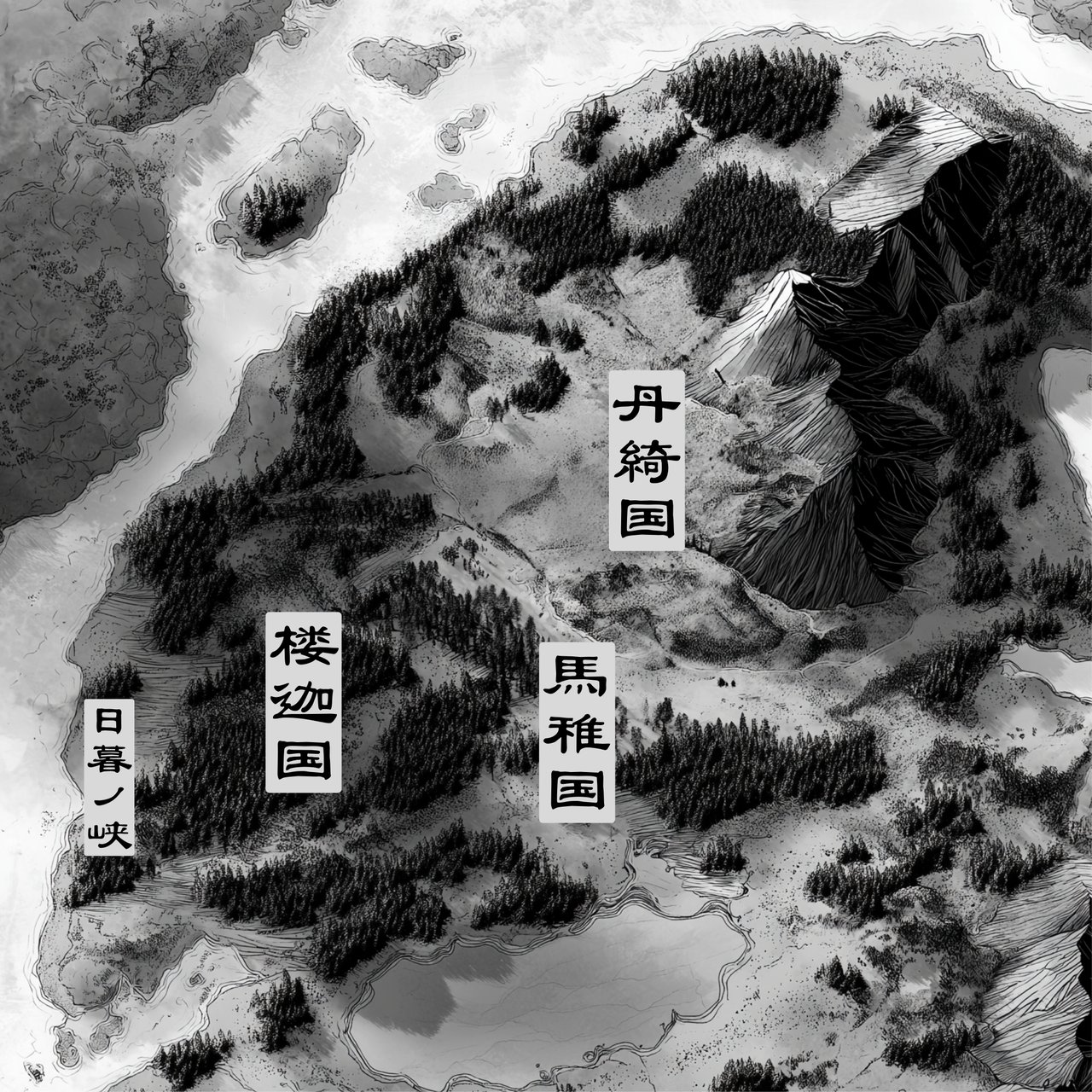
One of the central countries of Yakuji. It is home to Shironomiya in the southeast, but there are forces that tire of Shironomiya's influence.
Umawaka Castle is located in the capital, Ouka, and it is ruled in a feudal style by the Shogun. Shironomiya also has a guard corps called the "Shugo", and Umawaka provides its soldiers.
Umawaka mainly worships Hitsukino Nagakami, who is at the center of mythology.
The soldiers are armed with plain wooden armor and helmets.
To the west of Shironomiya is Shimosugi Village, and to the north is Jabaseyama. To the west of Ouka is Akeba-no-Sho, and beyond that is the border with Ruka.
Rōkakoku
An empire located to the west of Umawakakuni. At its western edge is Higurashi Gorge, a taboo area.
While it is under the influence of Umawakakuni, it has established its own imperial system. The country is run by nobles and appears to be solid, but it is also plagued by rebellions. In the capital, institutions such as the police and financial authorities surround the Imperial Palace.
They worship Hotsuma no Kami, who is also a sun god.
The armaments of their soldiers vary depending on the organization.
Nikikoku
A country on the plains that spreads out to the northeast of Umawakuni. A militant nation that claims to dominate the plains, it is said to be ruled by a fearsome demonic queen. Its capital is Shuro, also known as the Vermilion City.
There are virtually no diplomatic relations with Umawakuni, and the influence of Shironomiya has no effect.
Faith is weak, but the faith of Hitsukinochojin and the war god Retsugao has infiltrated the country.
The soldiers are armed with vermilion armor and helmets. There is tension within the military, with the National Guard and National Military Army separated.
calendar and units
The people of Yakuri have their own unique calendar, units of measurement, and business practices deeply rooted in their lives.
seasonal
Just like modern Earth, there are twelve months in a year, and the seasons change.
Not only this, the world of Yakuji can be said to be a mirror image of modern Earth, resonating with it across dimensions and space-time.
A week is also divided into seven days, and a god is assigned to each day of the week.
Sunday Hitsukinocho (Higashinoato)
Monday Hitsukinocho (Nishinoato)
Tuesday Hizushinokami
Wednesday Mizunayanokami
Thursday 〓〓〓〓 Vacant or same as Wednesday (Minaya)
Friday Rekkao
Saturday Yowatatanokami
unit
The unit of currency is called "kai." It is a remnant of the shell currency system. One kai, ten kai, and one hundred kai are copper coins with holes. A thousand kai are iron coins. Ten thousand kai are silver coins. A hundred thousand kai are gold coins. One kai is roughly equivalent to one yen in modern Japan. Copper coins are tied together with a string.
In international transactions, 100,000 kai gold coins and pledge certificates are used.
The following are the same as traditional Japanese units.
Time: "Koku (approximately two hours)"
Length: "Sun, Shaku, Jo, Kan, Ri"
Weight: "Momme, Ryo, Kan"
Volume: "Go, Masu, To, Koku"
Area: "Tsubo, Tan, Cho"
Overview of Shiranomiya
Shironomiya is an organization that boasts great magical powers, centered around its high priestess.
While nominally and located within the country of Umawaka, it has influence in other countries as well.
Overview of Shiranomiya
Shironomiya is an organisation that boasts great magical powers, centred around its high shrine maiden. While it nominally belongs to the country of Umawaka, it has influence in other countries as well. About four ri southeast of Umawaka's capital, Oshika, a group of white wooden buildings appears in the forest beyond a pass. The view is like a cluster of white flowers blooming in a sea of trees.
Architecture of Shironomiya
Shironomiya covers an area of five acres (approximately 500 square meters). The outer perimeter is surrounded by a plain wooden wall, and there is a lookout tower. The main gate faces west, facing the road to Oshika. Almost the entire architecture of Shironomiya is made of beautiful plain wood. The foundation is made of cypress, and the whole is made of oak. It is decorated with vermilion and silver, and is decorated with carvings of the chief deity Nagakami, white flowers, and other gods. Many soldiers from Umawakokuni are stationed at the palace, providing security as "guardians". The guardian armor is made of golden bronze (before the Age of Eclipse) or plain wood armor from Umawakokuni (after the Age of Eclipse). In the center of Shironomiya is the main palace, the largest palace, with three floors.
Shironomiya Outer Shrine
The seven Outer Shrines are as follows: Hozumi Palace, where food is stored. Shugo Palace, which is the guard station. Keisa Palace, which is used to entertain guests and for festivals. Hinaso Palace, where apprentice shrine maidens live. Fumiyomi Palace, which keeps books and other items. Kamutsunagi Palace, which is used for ceremonies. There is a prison in the basement of Shugo Palace, where rebels and shrine maidens with mental disorders are sometimes imprisoned.
white flower faith
The shrine maidens of Shironomiya have always used a perennial flower called shirohana in their rituals, and have always treasured it. It is said that the world was better ordered in ancient times, and they are trying to recreate the ancient ideal world known as "Shirakakyo."
Site map of Shironomiya
Main Shrine (center) Main gate (west) Fumyomi-no-miya (east) Hinasu-no-miya (southeast) Hozumi-no-miya (north) Kamitsuna-no-miya (south) Kesha-no-miya (northwest) Shugo-no-miya (southwest) Barracks (northwest side of Main Shrine) Training grounds for the guardians (southwest outside the grounds) Other, older documents mention the existence of unidentified shrines such as "Kotoimi-no-miya" and "Tootonai-no-miya".
shrine maiden
There are ranks from first to fourth, with the high priestess at the top. Apprentice priestesses start as fourth-rank priestesses, and those who have attained tamauke (reception) become third-rank priestesses. From there, they can move up in rank over one to three years of training. There are only a few first-rank priestesses, and they are in a position to essentially direct the running of the shrine. Reikeuke means forming a bond with a specific god. Those who have not attained tamauke by about age fifteen may leave Shironomiya or become servants. As for clothing, they wear white kosode with silver and white flower crests on both sides of the chest, and scarlet hakama. Hair is held in place with silver mizuhiki. During festivals, they wear formal attire. High priestesses wear white hakama and a silver crown. The crown resembles a long god and a white flower.
.. Under construction ..